
What E-Manifest Is
The FedCash E-Manifest Service is the Federal Reserve's electronic replacement for the paper manifest. Today, when a carrier delivers a bank's currency deposit to a Federal Reserve cash office, or collects a bank's currency order there, the bags are matched against a paper manifest at the dock and signed for by hand. With E-Manifest, the manifest travels ahead as data, every bag is scanned against it, and an electronic receipt takes the place of the signature.
It is the Fed's part of a wider industry effort called Cash Visibility, which uses GS1 barcode standards so that every handover of cash, from bank to carrier to the Fed and back, can be seen and reconciled as it happens.
Not the EPA's e-Manifest. The Environmental Protection Agency runs a system with a similar name for hazardous waste shipments. It has nothing to do with cash. Everything on this page is about the Federal Reserve's service.
Timeline And Take-Up So Far
- 2013The Fed and the industry begin talks on Cash Visibility and a common data standard for cash packages.
- 2022The Fed reports E-Manifest in production.
- February 2023The Fed pilots currency deposits and orders over its API. Its pilot and early-adopter group: five carriers (two large, three regional) and eight banks.
- October 26, 2023The Fed announces broad availability to every financial institution customer of the Federal Reserve Banks and the armored carriers that serve them.
- 2024Eight of the largest US banks, Loomis, GardaWorld, three independent carriers and IACOA sign a GS1 US statement committing to adoption plans by the end of 2024.
- 2025The Fed reports the service has grown to almost 500 financial institution endpoints, meaning bank locations that deposit and order cash with the Fed.
- TodayStill voluntary. The Fed has announced no date for making it a requirement.
The Fed does not publish a running count of carriers or a share of Fed dock volume, so the 500 endpoints are the best public measure of take-up. Large and regional carriers were both in the early group, and the Fed publishes early adopters' own accounts on its E-Manifest pages.
How A Handover Works With E-Manifest
The Fed describes the exchange in four steps.
- The manifest is created and posted as dataIt is called a What-to-Expect (WTE) file, and it carries essentially the same information as a paper manifest. For a deposit, the carrier sends the Fed the WTE for its bank customers' bags. For an order, the Fed provides the WTE.
- The other side retrieves itBoth parties know what is coming before the truck reaches the dock.
- Every bag is scanned and reconciledEach bag carries a barcode called an SSCC, and each one is checked against the WTE, so a missing or unexpected bag shows up on the spot instead of in a later reconciliation.
- An electronic receipt completes the transferThe e-receipt is the equivalent of signing the paper manifest. For a deposit, the Fed issues it once the deposit is received. For an order, the carrier generates it for the cash paid out.
The Fed also asks carriers to think beyond its own dock: to share the same deposit and order data with their bank customers, and at other carriers' loading docks. The Fed says that digital exchange increases efficiency, cuts dock time and reduces proof-of-delivery requests.
Do You Have To Adopt It?
Not today. The Fed's FAQ says adopting the E-Manifest Service is not a requirement at this time, and the Fed charges no fees to use it. Three things point the same way, though.
- The Fed asks carriers to be ready early. Its checklist for armored carriers encourages them to reach E-Manifest readiness as soon as possible.
- The Fed expects it in the long term. In its spotlight video with an early-adopter carrier, the Fed says E-Manifest "will be needed to do business with the Federal Reserve long-term."
- The banks have committed. In a 2024 GS1 US statement, eight of the largest US banks, Loomis, GardaWorld, three independent carriers and the Independent Armored Car Operators Association (IACOA) committed to working toward full adoption of the GS1 standards behind Cash Visibility. Every signatory not already adopting committed to an adoption plan by the end of 2024.
For an independent, the pressure arrives through its bank customers. When a bank moves to E-Manifest at the Fed, it needs the carrier that runs its Fed deposits and orders to move with it, and the Fed encourages banks to raise E-Manifest with their carrier early.
What A Carrier Needs
The Fed's checklist for armored carriers, and its FAQ, come down to four things.
1. A Global Location Number (GLN) for each location
At minimum, one GLN for each location or branch that handles your bank customers' Fed currency deposits and orders. If you will need many, a GS1 Company Prefix lets you create your own; otherwise GLNs can be licensed one at a time.
2. SSCC barcodes on your cash bags
Each plastic shipping bag, or the plastic tag on a containerized shipment, needs a GS1 Serial Shipping Container Code (SSCC) barcode in the Fed's 20-digit format. The barcode can carry your own GS1 prefix, or you can buy off-the-shelf barcoded bags that use your supplier's prefix. The Fed accepts both.
3. Handheld scanning with a cellular connection
The Fed asks for scanning at the point of pickup and delivery, not only at the Fed dock, on handheld equipment with a cellular connection.
4. Integration software with an API
The Fed lists this as a requirement for a carrier that adopts E-Manifest. The software has to create and receive WTE files and e-receipts through the Fed's application programming interface (API). The Fed says it may come from a fintech or be built in-house, and it notes that many carriers already outsource their software.
GLNs And SSCCs, Explained
- GS1 and GS1 US
- GS1 is the not-for-profit body behind retail barcodes. GS1 US administers its standards in the United States and licenses the numbers below. The E-Manifest Service uses the GS1 US license.
- GLN, Global Location Number
- A GS1 number that identifies a place: a vault, a branch, a loading dock. It tells everyone in the exchange where a bag came from and where it is going.
- SSCC, Serial Shipping Container Code
- A GS1 number, printed as a barcode, that identifies one bag or container. It is what gets scanned against the WTE at every handover.
- GS1 Company Prefix
- Your organization's own block of GS1 numbers, from which you create GLNs and SSCCs. It is optional for E-Manifest: GLNs can be licensed individually, and barcoded bags can come with the supplier's prefix.
- WTE file and e-receipt
- The What-to-Expect file is the digital manifest. The e-receipt is the digital signature that closes the handover.
GS1 US publishes its pricing and licensing for banks and carriers on its banking pages, linked under Sources.
A Readiness Checklist For A Small Carrier
A practical order of work. None of it needs an IT department of your own, because the Fed lets the software come from a fintech.
- List every location that handles Fed deposits or orders for your bank customers. Each one needs a GLN.
- Talk to your bank customers. Find out which of them use Federal Reserve cash services directly, and whether they plan to adopt E-Manifest.
- Decide on bags. Ask your bag supplier for the Fed's SSCC format, or decide whether your own GS1 prefix is worth it.
- Check your scanning. The Fed asks for handheld scanning with a cellular connection. Test the phones or handhelds you already have against real barcoded bags before you buy anything. Start with our phone test below.
- Choose how you will connect to the Fed: build the API integration yourself, or work with a fintech. Either way, it can sit beside the operations system you run today.
- Submit the Fed's expression of interest form. The Fed's E-Manifest Readiness Program team reviews it, assesses your readiness, and sets up regular meetings and developer support through onboarding.
- Plan the record. Keep every WTE file, scan and e-receipt as your chain of custody, ready for the day a bank, an insurer or an auditor asks.
Test Your Phone Now
1Open the test on your phone. Scan this QR code with the phone's camera.Tap the button below.
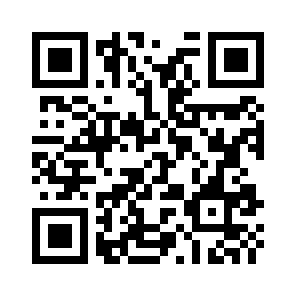 Open The Scan Test
2Tap Start, then point the phone at this barcode. It is a test SSCC in the GS1-128 format cash bags carry.
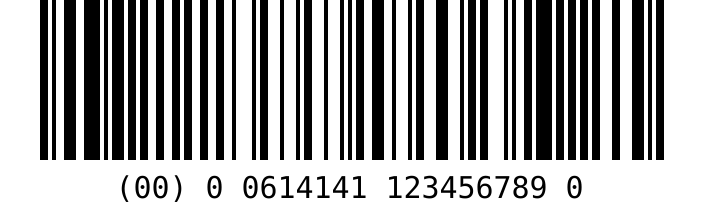
3A beep and a green tick mean your phone can read E-Manifest bag barcodes in a web app, with nothing to install. Reading this on your phone already? Open the test and scan the barcode on another screen, or print it from the test page.
How TNC Helps
We build software for independent armored carriers, and getting independents ready for E-Manifest is where our US work starts. Two pieces already run in production:
- The same handover, digitally, at SBV, South Africa's equivalent of FedCash: every bag scanned against what was expected, both sides signing on the phone, and a proof of delivery for every handover.
- Bag-level scanning at the depot, where the crew and the vault scan the same bags into one live tally on any phone, even without signal, beside the operator's existing system.
For a US independent that means help with the GLN and SSCC setup, scanning on the phones your crews already carry, and the API connection that sends and receives WTE files and e-receipts, with the records kept as your chain of custody. The Fed connection is the part still being built, and we want to build it with the operators who will run it. Pricing runs per module and per route or depot, so a small fleet pays a small bill.
Questions Carriers Ask
Is E-Manifest mandatory?
Not at this time, according to the Fed's FAQ. The Fed encourages carriers to get ready as soon as possible and says the service will be needed to do business with the Federal Reserve in the long term.
When will the Fed start requiring it?
The Fed has not announced a date. It describes the current absence of a requirement as time for the industry to invest and adjust, while saying the service will be needed in the long term.
How many banks and carriers use it?
The Fed does not publish a running total. Its pilot ran with five carriers and eight banks, and by 2025 it reported almost 500 financial institution endpoints on the service.
Does it cost anything?
The Fed charges no fees for the service. A carrier's own costs are the barcoded bags, any GLNs or prefix licensed from GS1 US, scanning, and the integration software.
Do we need new handheld scanners?
The Fed asks for handheld scanning with a cellular connection. A recent smartphone with a good camera can scan bag barcodes in a secure web app, which is how our own handover systems work. Our phone test takes under a minute, and then test with your own bags before you decide.
Do we have to replace our operations system?
No. The Fed lets the integration come from a fintech or be built in-house, and it can run beside the system you already use.
Does the Fed work with fintechs?
Yes. The Fed's FAQ says carriers may use a fintech to develop or add the capability, and it invites fintechs that serve carriers to complete its expression of interest form.
Who do we contact at the Fed?
Start with the E-Manifest expression of interest form on the Fed's site. The Fed's E-Manifest Readiness Program team follows up from there, and its E-Manifest pages list a contact address for questions.
Sources
- Federal Reserve Financial Services: FedCash E-Manifest Service
- Federal Reserve Financial Services: Cash Visibility frequently asked questions
- Federal Reserve Financial Services: E-Manifest guidance for armored carriers and financial institutions (PDF, revised June 2026)
- Federal Reserve Financial Services: E-Manifest expression of interest form
- Federal Reserve Financial Services: spotlight video with an early-adopter armored carrier (YouTube)
- Federal Reserve Financial Services: press release announcing broad availability (October 26, 2023)
- Federal Reserve Financial Services, entry for the International Association of Currency Affairs' 2025 Currency Awards: FedCash E-Manifest Service paving the path for Cash Visibility (the history, the pilot and the endpoint count)
- GS1 US: The Time for Cash Visibility Is Now, the industry joint statement (PDF, 2024)
- GS1 US: banking and Cash Visibility, including GLN and prefix licensing
This guide summarizes public material from the Federal Reserve and GS1 US as published on October 13, 2026. It is not the Fed's own guidance: check the linked pages, and talk to the Fed's Readiness Program team, before you plan around it. FedCash is a service mark of the Federal Reserve Banks. TNC Software is not affiliated with the Federal Reserve or GS1 US.